Tag: fantasy

  • The clock.

    The clock.

    I hadn’t stepped foot in my father’s workshop for more than twenty years. I told myself it was complicated. It never really was. The passing of time has a funny way of kicking you right in the teeth. We only realize things weren’t that complicated once it’s too late to fix them.

    I stand outside the red building in the backyard of his house for what feels like another twenty years. I call it his house because it stopped being my home a long time ago. The building was red once, but now it’s a dull rust color, with patches of green moss creeping across the wooden siding.

    The door creaks and groans as I open it. The room smells like sawdust and wood stain. Dust floats in the air, passing through columns of light from the windows. It’s quiet, almost peaceful, but empty. Empty of the person who gave it purpose. I realize that me and the workshop are one and the same, orphaned, left behind, empty.

    A workbench stretches along the back wall. Tools are scattered across its surface, as if someone left them there with every intention of using them again.

    “He’s not coming back,” I whisper, picking up a chisel.

    I consider hanging it on the wall, where it belongs. In the end, I lay it gently back down.

    Everything in the room is just as I remembered it. I half expect my father to walk in, hunched over, cane in one hand, and mutter, “Are we ever going to finish that darn clock?”

    But he’s gone.
    And the clock is nowhere to be seen.

    I start walking around, taking stock. Soon I’ll have to decide what to do with all of it. I pull out my phone and open a note:

    circular saw… sale.
    screwdrivers and chisel set… sale.
    hammers… sale.

    No sense keeping any of it. I don’t have the room. In the corner are a few boxes, probably more tools or magazines. He never threw anything away, just moved it out here, in case he needed it one day.

    I’m on the third box, maybe the fourth, when I find something wrapped in a blanket. It’s solid. I lift it out and place it on the workbench, then carefully unwrap the fabric.

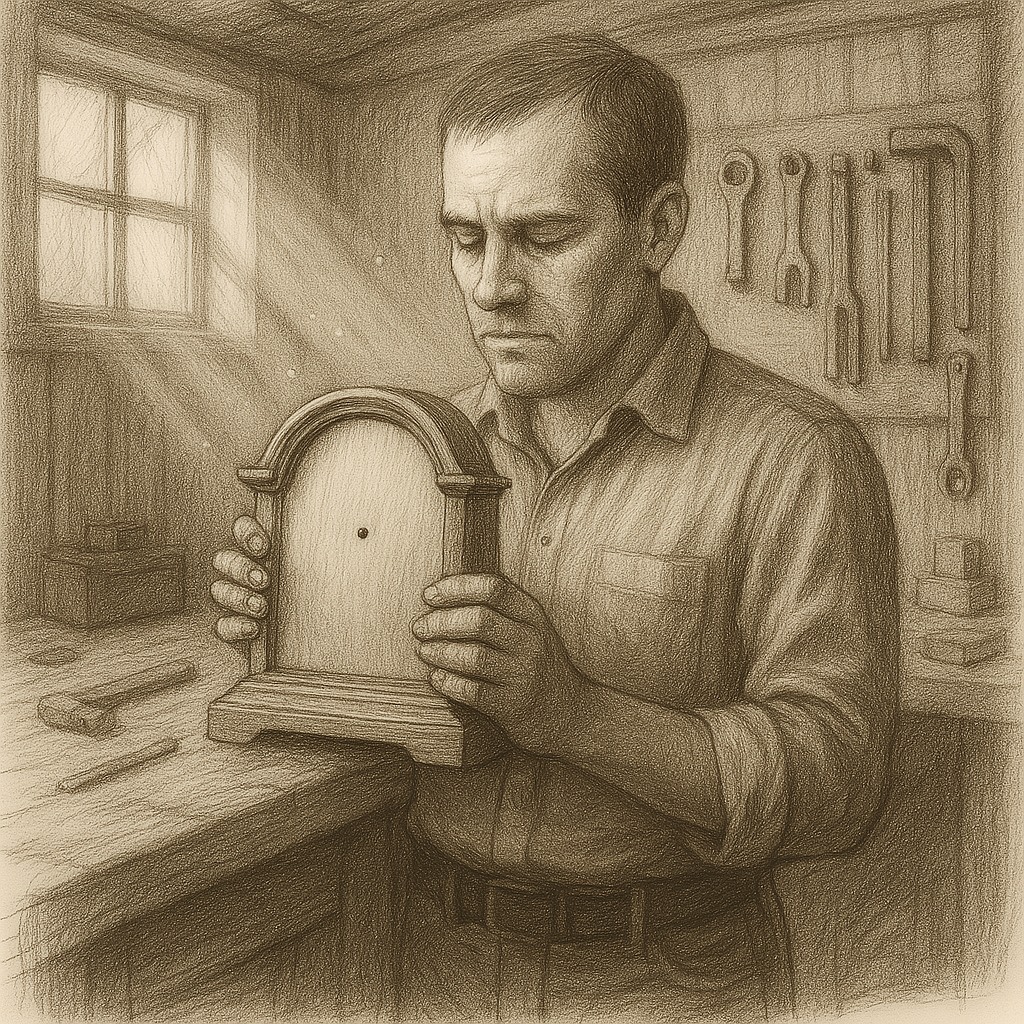
    The face of the clock is blank. No numbers. No hands. The cedar wood is smooth, untouched by stain or varnish. I remember the night we started it. He’d ordered a gear kit online and carved the casing from a block of cedar. I sat on a stool and watched him chip away at the wood until he was satisfied with the shape. Occasionally, he’d let me try, but what he really needed was my help with the gears. Parkinson’s hadn’t fully stolen his ability to work the chisels yet, but he couldn’t hold the tiny screws needed to assemble the clock’s movement.

    Now and then, he’d give me a nod, his quiet way of saying I was doing something right. Other times he’d mutter, “Ain’t it ironic we’re building a clock? At the rate you’re going, we’ll run out of time before we finish it.”

    It wasn’t ironic at all.

    I turn the piece over in my hands, trying to see how far he got. On the bottom of the clock, in shaky ink, are the words:

    “To be completed with my son.”

    I bring the clock to my face. Tears soak into the bare wood. The dust swirls in the rise and fall of my chest. I gave up a long time ago, but he hadn’t. He waited. He watched time pass too quickly. Watched dust settle too thickly. Until, eventually, time ran out, and the dust buried him.

    I take out my phone and open the list again:

    circular saw… keep.
    screwdrivers and chisel set… keep.
    hammers… keep.

    “Dad,” I whisper, “let’s finish the darn clock.”
  • The messenger.

    The messenger.

    The envelope was heavier than it should have been. Not just thick, dense, like a concrete block wrapped in twine. Cal stood at attention, mud soaking into his boots, while the sergeant scribbled in a pad on his desk. Cal didn’t move. He waited, frozen, until the orders came.

    “Last I heard, the route should be clear,” the sergeant said, not looking up. “Don’t lollygag. You’re not sightseeing. You’ll find them just over the ridge.” He pointed to a spot on the map. “There and back. Easy.”

    Easy.
    Orders were orders, easy or not, and Cal followed them.

    He checked his pack, the sealed envelope secured, a piece of leftover bread from yesterday, and on his hip, a pistol he’d never fired.

    The flap of the tent snapped open.
    “Why are you still here?” the sergeant barked.

    Cal jumped, nearly spilling the contents of his bag.

    “I’m leaving now, sir!” He saluted and hurried off.

    Smoke hung in the air like dust on glass. The ridge loomed ahead, its earth broken and moist. The world was still, quiet, as if it were sleeping off something heavy. Cal crouched low, heart pounding like a drumline in his chest. The route was supposed to be clear. That’s what the sergeant said. And it was clear, too clear. Something had happened here. Not long ago.

    At the bottom of the crest, he saw it, the post where his fellow soldiers had camped. Now wrecked. Packs scattered, chairs broken, tables overturned, tents flattened. A mess of struggle. Not a soul in sight. He could’ve turned around. No one would’ve known. Could’ve said they moved on before he got there. But orders were orders, and Cal followed them. He counted ten sets of boot prints, all heading in the same direction. I’m not the guy for this, he thought, pinching the bridge of his nose. I need to go back. Get help. He wasn’t a hero. He delivered letters and packages. His job was safe, simple. But now, there were eleven sets of boot prints,
    Cal’s boots among them.

    The trail led to a camp tucked in the trees. He wouldn’t have seen it if not for the firelight. Twigs snapped underfoot, each one screaming, He’s over here! His stomach flipped. Bile stung the back of his throat. The footprints deepened. One set vanished into a drag mark. Someone was injured. Three enemy soldiers. One asleep, feet propped on a box, chair barely balanced. Two others patrolled the camp, weapons dangling lazily at their sides.

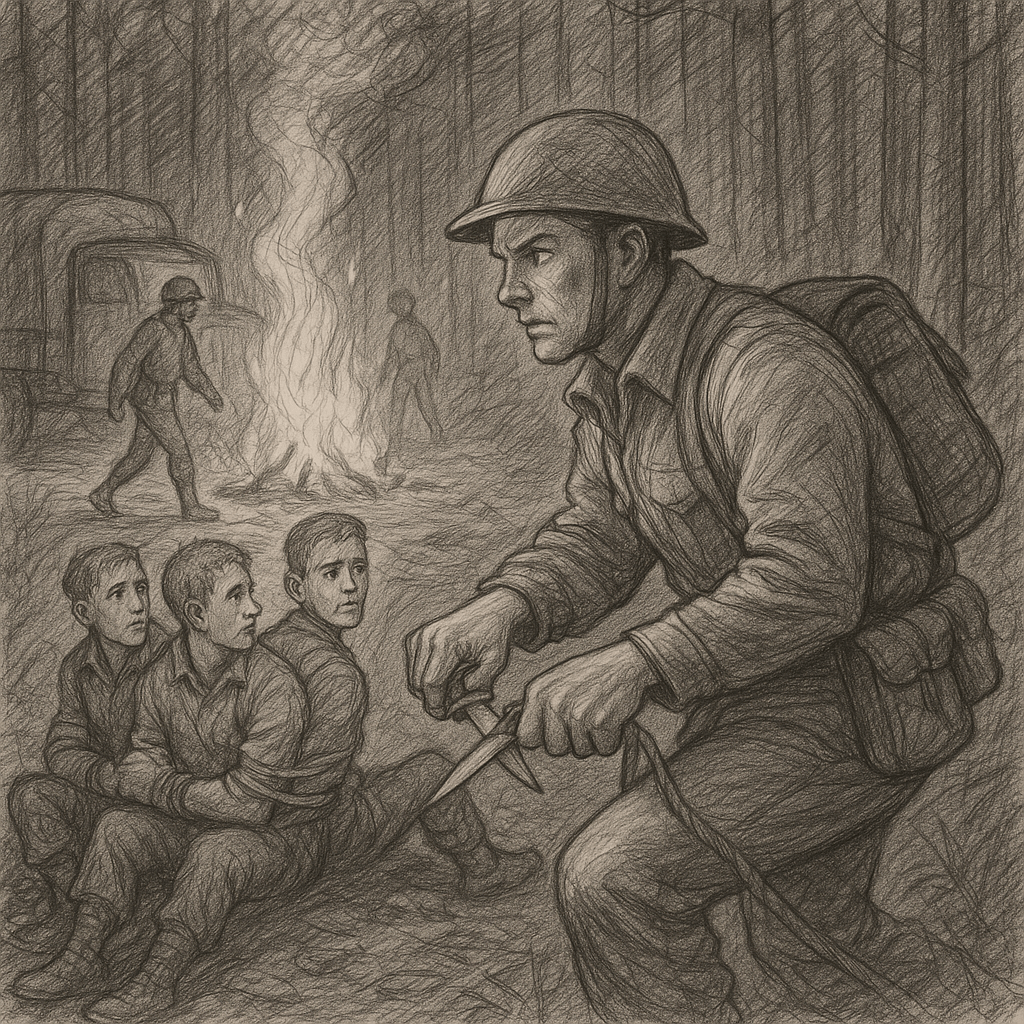
    Cal dropped to his belly and crawled forward, pine needles biting his palms. He couldn’t shoot, not three of them. Even if one was asleep, he couldn’t hit the broad side of a barn. He spotted a pile of brush near the edge of the camp, leftover from clearing the site. A distraction. He sparked his flint. Sparks licked the dry wood until flames bloomed. He waited, letting them hum, roar, and spit smoke through the trees. The guards shouted and bolted toward the fire. Cal stayed low, weaving through shadows, searching. Near a covered truck, he found them, his men, tied together with rope.

    One soldier spotted him. “Messenger?”

    Cal nodded, pulling a knife from his boot and sawing at the rope.

    “You need to go,” the soldier whispered, motioning to the woods. “They’ll be back.”

    “I set a fire,” Cal said. “It’s big. They’ll be busy for a while. We’ll catch up later. Just move!”

    One of the men stared at him, wrists still bound with frayed rope. “Why’d you come?”

    “Because no one else was,” Cal said.

    He grabbed the last man by the arm and yanked. The freed soldiers bolted into the forest, alive, just barely. Cal followed, lungs burning, a scrap of rope still clutched in his fist.

    Whether it was easy or not, orders were orders, and Cal followed them.