Tag: history

  • The messenger.

    The messenger.

    The envelope was heavier than it should have been. Not just thick, dense, like a concrete block wrapped in twine. Cal stood at attention, mud soaking into his boots, while the sergeant scribbled in a pad on his desk. Cal didn’t move. He waited, frozen, until the orders came.

    “Last I heard, the route should be clear,” the sergeant said, not looking up. “Don’t lollygag. You’re not sightseeing. You’ll find them just over the ridge.” He pointed to a spot on the map. “There and back. Easy.”

    Easy.
    Orders were orders, easy or not, and Cal followed them.

    He checked his pack, the sealed envelope secured, a piece of leftover bread from yesterday, and on his hip, a pistol he’d never fired.

    The flap of the tent snapped open.
    “Why are you still here?” the sergeant barked.

    Cal jumped, nearly spilling the contents of his bag.

    “I’m leaving now, sir!” He saluted and hurried off.

    Smoke hung in the air like dust on glass. The ridge loomed ahead, its earth broken and moist. The world was still, quiet, as if it were sleeping off something heavy. Cal crouched low, heart pounding like a drumline in his chest. The route was supposed to be clear. That’s what the sergeant said. And it was clear, too clear. Something had happened here. Not long ago.

    At the bottom of the crest, he saw it, the post where his fellow soldiers had camped. Now wrecked. Packs scattered, chairs broken, tables overturned, tents flattened. A mess of struggle. Not a soul in sight. He could’ve turned around. No one would’ve known. Could’ve said they moved on before he got there. But orders were orders, and Cal followed them. He counted ten sets of boot prints, all heading in the same direction. I’m not the guy for this, he thought, pinching the bridge of his nose. I need to go back. Get help. He wasn’t a hero. He delivered letters and packages. His job was safe, simple. But now, there were eleven sets of boot prints,
    Cal’s boots among them.

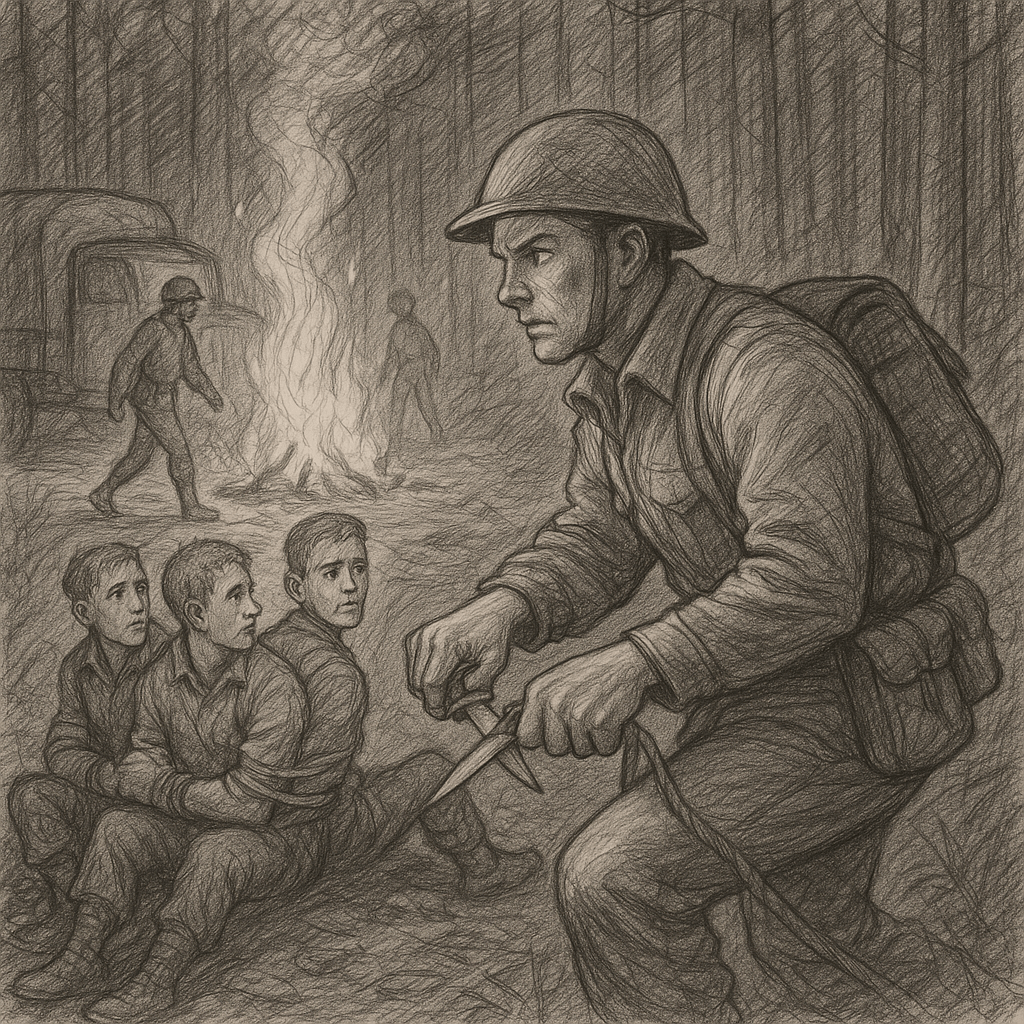
    The trail led to a camp tucked in the trees. He wouldn’t have seen it if not for the firelight. Twigs snapped underfoot, each one screaming, He’s over here! His stomach flipped. Bile stung the back of his throat. The footprints deepened. One set vanished into a drag mark. Someone was injured. Three enemy soldiers. One asleep, feet propped on a box, chair barely balanced. Two others patrolled the camp, weapons dangling lazily at their sides.

    Cal dropped to his belly and crawled forward, pine needles biting his palms. He couldn’t shoot, not three of them. Even if one was asleep, he couldn’t hit the broad side of a barn. He spotted a pile of brush near the edge of the camp, leftover from clearing the site. A distraction. He sparked his flint. Sparks licked the dry wood until flames bloomed. He waited, letting them hum, roar, and spit smoke through the trees. The guards shouted and bolted toward the fire. Cal stayed low, weaving through shadows, searching. Near a covered truck, he found them, his men, tied together with rope.

    One soldier spotted him. “Messenger?”

    Cal nodded, pulling a knife from his boot and sawing at the rope.

    “You need to go,” the soldier whispered, motioning to the woods. “They’ll be back.”

    “I set a fire,” Cal said. “It’s big. They’ll be busy for a while. We’ll catch up later. Just move!”

    One of the men stared at him, wrists still bound with frayed rope. “Why’d you come?”

    “Because no one else was,” Cal said.

    He grabbed the last man by the arm and yanked. The freed soldiers bolted into the forest, alive, just barely. Cal followed, lungs burning, a scrap of rope still clutched in his fist.

    Whether it was easy or not, orders were orders, and Cal followed them.
  • Frog Pond. The Third Part.

    Frog Pond. The Third Part.

    She nodded and leaned back slightly in her chair, her fingers folding over one another as if she were holding something precious between them.

    “Your father—he wasn’t loud like some of the other men at church. He was gentle, soft-spoken. Thoughtful. The kind of person who’d listen longer than he spoke.” Her voice wavered a little. Her eyes reddened.

    “When your mother sang in the choir, he’d sit in the front pew like she was the only one in the room. Never missed a Sunday. Never missed a chance to remind her how proud he was of her.

    I couldn’t help but smile. It was strange—he didn’t feel like a myth anymore. He felt like a man who’d hold a door open, who’d smell like old books and aftershave.

    Mrs. Rockner continued. “He once told me that he hoped to teach his child—not just to be good, but to be kind. ‘You can be both,’ he said. ‘Kindness takes strength.’” She tapped the cover of the Bible. “And faith takes that same kind of strength.”

    “So you we friends?” I asked, though I was certain I knew the answer.

    “Oh yes, great friends,” She answered. “He and my late husband worked the mines together. In fact, we moved to Frog Pond shortly after he arrived and met your mother.”

    I had heard the stories of how they met. My father arrived in Frog. Pond with nothing but ambition and a suitcase. I am not sure why he settled here. Mother always told me that it was never his intention to stay. Yet, when he met her all those plans went with the wind.

    As the story goes my father arrived on a Sunday morning. He walked through the door of New Jerusalem Baptist church carrying a suitcase. Removing his hat from his head, he placed it against his chest and mouthed, “excuse me.” The preacher stared him down. He should have thanked him though. The man had been preaching with such veracity that the veins in his neck were throbbing. It is possible that my father saved that man’s life. Bless God, he may have croaked preaching the good news. Father sat in the back row, and made sure to give as many “amens” as possible in the remaining five minutes of the sermon. 

    “With every head bowed and every eye closed,” The preacher began his prayer. My father didn’t close his eyes. In the front row sat my mother. Her blonde wavy hair spilling over the back of the pew. He hadn’t been in Frog Pond more than a day, but he knew at that moment he found a home, he found his wife. 

    Every Sunday he returned to the church, eventually he made a habit of going to the evening service too. It was a good ole’ fashioned southern gospel singing. No preacher, just the acapella sound of songs like I’ll fly away and Victory in Jesus. He couldn’t hold a tune in a bucket, but she was there and that meant he was too. It took a while for him to work up the nerve to speak to her. Every week he would move up a pew, until finally he sat next to her, stuck out his hand and said, 

    “My name is Thomas Watson Sanders, and you don’t know this yet, but you will be my wife one day.” If it were any other woman, she would have ran until she reached the Gulf of Mexico, but Mother offered her hand and said, “It’s nice to meet you Mr. Sanders.” 

    I ran my fingers along the cracked spine again, tracing the gold that had survived time and handling. Something stirred in me—something warm, something anchored. For the first time, I didn’t feel like a question waiting to be answered. I felt seen. Rooted.

    “Can I take it home?” I asked.

    “Of course,” she said. “It’s yours. Always has been.”

    As I left the classroom with the Bible tucked beneath my arm, the whispers and stares from earlier didn’t feel so heavy anymore. They were just noise. I had something real now. Something that had passed through his hands and now lived in mine. And as I walked into the church house and slipped into the pew beside my mother, she looked down at the Bible and then up at me.

    Her eyes filled. She didn’t say a word.

    She didn’t have to.

    The church though, was not only where my father met my mother for the first time, it was also the place I met him for the first time.

  • Frog Pond. The Second Part.

    Frog Pond. The Second Part.

    I sat in Sunday school and listened to my teacher talk about Jesus. Mrs. Rockner was reading to us from John 19:27, “Then saith he to the disciple, Behold thy mother! And from that hour that disciple took her unto his own home.” I raised my hand and she called on me to ask my question. 

    “Did Jesus have a father?”, I asked. This was very out of character for me. I rarely ever spoke unless I was spoken to, and never asked questions in fear that I was asking the wrong one. 

    “He was the son of God, doofus”, one of the boys in the back of the room shouted.

    The room erupted in laughter and had my tie not been a clip on I would have choked from the knot that formed in my throat. Mrs. Rockner raised one boney finger to her mouth and shushed the class. 

    “We will not call anyone a doofus in God’s house”, she said behind her clenched teeth. “Tommy”, she called out to me. “Tommy, Joseph was Jesus’ father, but the Bible doesn’t speak a lot about him. It is possible that Jesus grew up without a father.” She grinned at me. She knew why I was asking. I raised my hand again. 

    “Yes, Tommy?”

    “So Mary was a single mom? She took care of Jesus all on her own until he was a grown up?” 

    “I guess you could say that.” She answered, her eyes peering at me over the rim of her glasses. She cleared her throat and continued to teach the class. I couldn’t believe what I was hearing. We came to this building three times a week, twice on Sundays, to talk about him, sing songs about him, we even talked to him, and he was raised by a single mom. Jesus was an important person, and Jesus didn’t have a father. 

    A boy in my class raised his hand, and Mrs. Rockner called on him. 

    “Wasn’t God the father of Jesus?” 

    Mrs. Rockner shook her head in approval. “He was indeed, but I think Danny was curious if Jesus had an earthly father. Isn’t that right Danny?”

    I nodded my head, but kept it hanging below my shoulders. 

    “God is everyone’s heavenly father if they believe in Jesus”, Mrs. Rockner said. 

    I wasn’t sure what she meant by “believing in Jesus” but, if believing in Jesus meant I could have a father, and Jesus was raised by a single mother I wanted to believe in Jesus. I raised my hand again. 

    “I believe in Jesus because he was raised by a single mother.” I could hear tiny whispers travel through the room. Several of my classmates were talking in each other’s ears and covering their mouths with their hands. I knew they were talking about me. They were always talking about me. They were always waiting for me to ask a stupid question, or say something strange. I was different. In fact, I was more like Jesus than any of them. All of them had fathers. I sat there, pinching the skin of my left index finger. I did this when I was nervous. Mrs. Rockner was facing the chalkboard writing our memory verse for the week. She smiled at me, the whispers stopped. 

    “And will be a Father unto you, and ye shall be my sons and daughters, saith the Lord Almighty.” 

    “Tommy, I think that is a great thing. A really great thing,” she said, turning from the chalkboard. 

    Sunday school always ended promptly when it was time for it to. Usually Mrs. Rockner would escort us all to the church house so that we could sit with our parents. Well, in my case it’s just one parent. This particular Sunday, Mrs. Rockner asked me to stay behind and sent everyone else out of the classroom. 

    “Tommy, would you mind staying back with me for a moment?” Without protest, I obliged to her request. This was a welcomed reprieve from the quiet insults thrown at me like tomatoes from the other kids in my class. 

    “Yes, Mrs. Rocker.” I said, walking toward the small desk that sat in the back of the room. She patted the seat of a chair next to the desk, signaling for me to sit down. 

    She always carried a large bag with an embroidered cat on the front of it. I haven’t a clue what she carried in it, or why a person would need something the equivalent size of a suitcase with them at all times. Regardless, after I agreed to her request she started to dig into her bag, looking for something. The bag with its wide mouth appeared to be swallowing her whole until finally she emerged with a leather bound book. 

    “Sorry, I keep my life in the bag. Sometimes things hide from me.” She blew a piece of hair out of her face, and took a deep breath. 

    “Thomas, I have noticed that you ask a lot of questions. Sometimes they are questions that are difficult for Mrs.Rockner to answer. You are a very inquisitive young man.” My face scrunched and my head tilted to the side when she said this. 

    “What I mean is that you want to know a lot about things.” She placed the leatherbound book on the table in front of me. On the front cover, in gold inlaid letters was my name. Thomas Watson Sanders. 

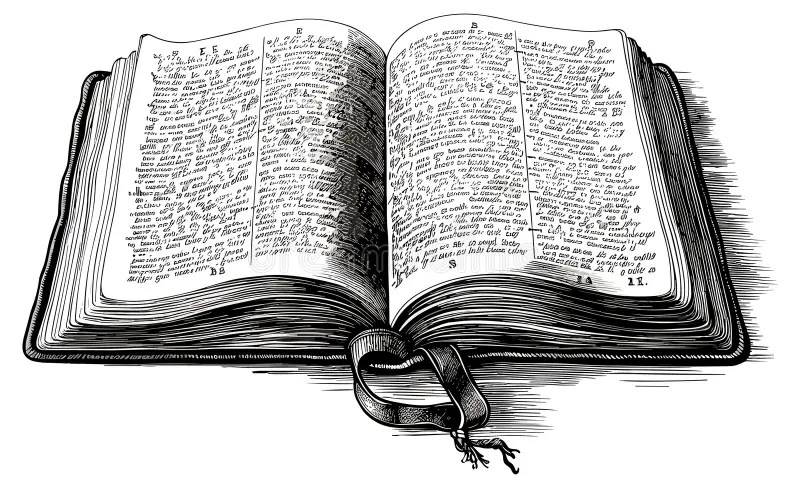
    She placed her hand on the book and looked at me. “Tommy, this is a Bible. Not only is this the Bible, but it is your Bible. See, it has your name on it.” She pointed to the gold letters. The book was worn, and the leather was dry and cracked. The edges of the cover were starting to tear. The gold gilding had long worn off, some of it was still visible though dull. I had never seen a book like it. Two columns of words on each page.The front of the book had a page for a person to put there name, births and deaths of family members, and even a place for marriages. On the page for the owners name, written in blue ink, 

    Presented to: Thomas Watson Sanders

    With Love. Your Wife, Elenore. 

    This was his. Held held it in his hands. I stared for what seemed like an eternity, running my fingers over his name, imagining what these pages would tell me if they could talk. I flipped page after page to find notes in his handwriting. This was the closest I had ever been to my father, and for just a moment time stood still. 

    “Years ago I found this while going through some old books in the church,” she placed a hand on mine. “He must have left it here the Sunday before the accident.” 

    I cried. I am not sure why it cried. I never grieved his death because I never knew him. How does a person miss something that they never had? I am certain that the feeling that I felt in that moment was grief, because for the first time my father became a real person to me, not some fantasy in stories, but a real person. I sucked up a wad of snot and gathered myself so that I could speak. 

    “Did you know him?” I asked. 

    “Oh yes, I knew him very well,” She said. “Would you like for me to tell you about him.”

    “Yes, very much so.”

  • 76.33 years.

    76.33 years.

    The average life expectancy of a person in the United States is 76.33 years. I don’t know how you feel, but that just doesn’t seem like a lot of time.

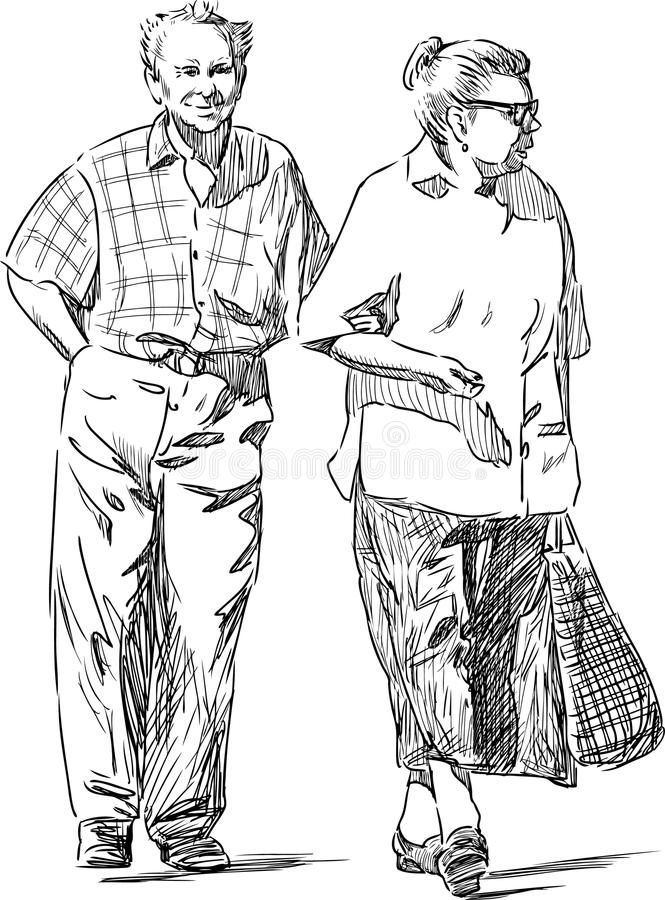
    Both of my maternal grandparents lived well into their 80’s, and over 50 of those years they spent together.

    We do not live in a time when people stick with things for very long. Boredom is the epidemic of the age. Mostly it’s because we are selfish people. Sounds harsh, I know. You know it’s true.

    On average a person changes jobs 12.4 times between the ages of 18 to 24.

    On average a person moves 11.4 times in their lifetime.

    On average 42% of all marriages end in divorce.

    These averages tell us something that I think we all know is true, and the sooner we admit them the more likely we will be to change them. We abandon ship the moment the ship fails to meet our needs. We don’t repair the sails, we replace them. We don’t patch the holes . We let the ship sink, cash in the insurance money, and buy a new one.

    The truth is, the new ship is just as susceptible to torn sails and holes as the old one was.

    I spent most of my childhood at my grandparents house. Almost every formidable memory I have was made there.

    My Nanna was a saint, and I’m convinced that if anyone was to be taken to Heaven in a chariot it would have been her. She was classy. Regardless of the itinerary for the day, she fixed her hair and put on make up. I can still smell the hairspray she used, and her perfume.

    My grandfather was a hard working man. He had rough hands. All of his pants were stained with dirt and grass. I do not recall a single moment that he didn’t have chewing tobacco in his mouth. He didn’t talk much.

    When I was a kid I received one spanking from my grandmother. Back then we had to go into the yard and pick our switch. For you non-southern folk, a switch is a thin piece of tree branch that felt like fire ants when you were hit with it.

    My grandfather wasn’t much for switches. He once chased my brother around the yard with a 2×4. I’m not sure what he did to deserve that, but thank the good Lord that he was fast on his feet.

    I was 11 years old when my grandfather died, and 22 years old when my grandmother died. It seems impossible to interpret my memories of them together in the context of marriage.

    They were very different people, with a very different outlook on the world. I never saw them hug or hold hands. I never saw them kiss each other goodnight.

    What I did see is my grandmother care for him when Alzheimer’s took over. I saw her next to his death bed, ushering him out of this life into another.

    I saw him work the ground to provide food for his family. I saw the house he worked to build. I saw a family gather around a table almost every night. A family he spent his life, sweat, and blood providing for.

    When they were together, I didn’t know it then, but they were teaching me about marriage. They were teaching me that the holes are worth patching and the sails are worth fixing. The ship may take on a little water, and it’s a whole lot of work to keep it.

    I always wondered how they made it through, but I get it now.

    Sailing isn’t easy, but it sure beats sinking.

    While newness is exciting I think what all of us really want is consistency in our lives. Maybe that is why we are so prone to move around, to change. What we don’t want to admit is that what we really want requires work, and nothing is more at war with our flesh than work.

    76.33 years isn’t long at all.

    Spend it how you want. I for one am learning how to repair sails and patch holes.

  • Ding, Ding.

    Ding, Ding.

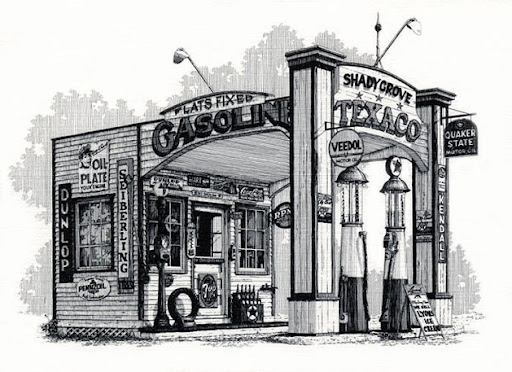
    Texaco gas station. Pleasant Grove, AL.

    I started my car today and got a mile from my house and the gas light came on. The sensible person would find the nearest gas station and fill up. I’m rarely sensible and I never fill up. It’s always the same. Five miles until empty and twenty on five please.

    I just don’t like pumping gas. It’s easy. It doesn’t take up much time. But, it’s awfully inconvenient. It reminded me of a time, not too long ago, when going to the gas station was quite literally one of the best parts of my week.

    The old school across the street was a tall two story building. The outside was wrapped in planks. White planks to be exact, though decades of age started to peel it away. A few yards from the front door of the old school was an out house. The structure was a relic. A monument of a time that was. All of town seemed to move away from that time. A new an improved school built behind it, and now an even newer school built down the road. The school was there before self check outlines at the grocery stores, and before two day shipping. It sat empty, watching over a town that had long since forgotten how important it was.

    Yet, across the street was the Texaco. There were two pumps, and a mechanic shop. There were other gas stations in town, more modern ones. I remember when car washes were installed. But, you couldn’t compete with the Texaco.

    As you pulled up you would run over the black cable that stretched across the lot. When you did a bell would ding with each passing of your tires. Ding. Ding.

    Upon your arrival a man in greasy coveralls approached your vehicle. I can’t remember his name but it was sewn into a patch on the breast of his outfit.

    On the side of each pump was a black bucket full of water with a squeegee. One side was a sponge of some sort and the other was made of rubber. The gentleman with either a cigarette in the corner of his mouth, or drips of tobacco hanging from his lip would tip his hat to you as he cleaned the windshield.

    “Five dollars please.” the financial exchange happened and the man began to pump your gas.

    I looked forward to this. The dinging of the bell. The windshield being cleaned. The place wasn’t clean by any means, but it sure was convenient.

    I didn’t know it then, but this place was the last of its kind. Sooner or later it would join the school house and watch as the world moved on with out it.

    We can leave the out house in the past, sorry old school, but I would give my last pair of socks to go back to that old Texaco.

    Ding, ding.