Tag: writing

  • The clock.

    The clock.

    I hadn’t stepped foot in my father’s workshop for more than twenty years. I told myself it was complicated. It never really was. The passing of time has a funny way of kicking you right in the teeth. We only realize things weren’t that complicated once it’s too late to fix them.

    I stand outside the red building in the backyard of his house for what feels like another twenty years. I call it his house because it stopped being my home a long time ago. The building was red once, but now it’s a dull rust color, with patches of green moss creeping across the wooden siding.

    The door creaks and groans as I open it. The room smells like sawdust and wood stain. Dust floats in the air, passing through columns of light from the windows. It’s quiet, almost peaceful, but empty. Empty of the person who gave it purpose. I realize that me and the workshop are one and the same, orphaned, left behind, empty.

    A workbench stretches along the back wall. Tools are scattered across its surface, as if someone left them there with every intention of using them again.

    “He’s not coming back,” I whisper, picking up a chisel.

    I consider hanging it on the wall, where it belongs. In the end, I lay it gently back down.

    Everything in the room is just as I remembered it. I half expect my father to walk in, hunched over, cane in one hand, and mutter, “Are we ever going to finish that darn clock?”

    But he’s gone.
    And the clock is nowhere to be seen.

    I start walking around, taking stock. Soon I’ll have to decide what to do with all of it. I pull out my phone and open a note:

    circular saw… sale.
    screwdrivers and chisel set… sale.
    hammers… sale.

    No sense keeping any of it. I don’t have the room. In the corner are a few boxes, probably more tools or magazines. He never threw anything away, just moved it out here, in case he needed it one day.

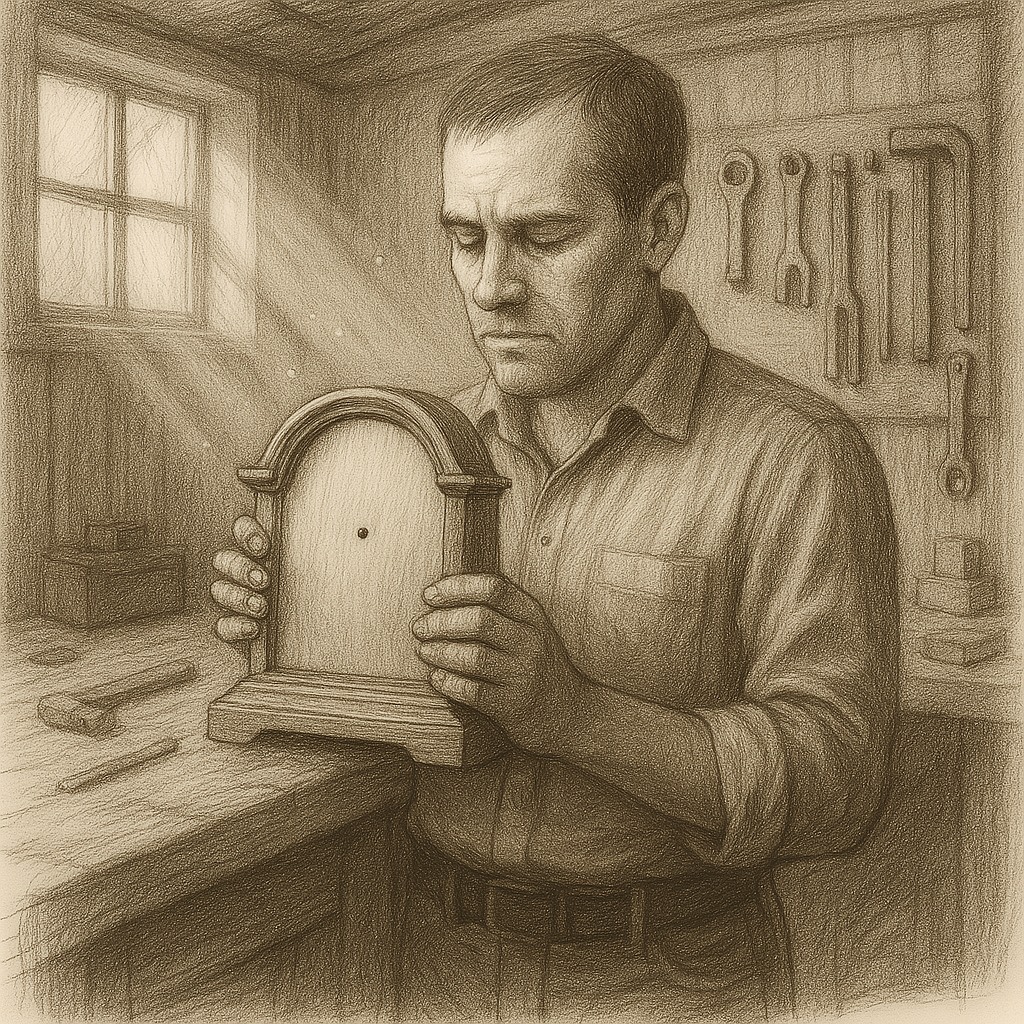
    I’m on the third box, maybe the fourth, when I find something wrapped in a blanket. It’s solid. I lift it out and place it on the workbench, then carefully unwrap the fabric.

    The face of the clock is blank. No numbers. No hands. The cedar wood is smooth, untouched by stain or varnish. I remember the night we started it. He’d ordered a gear kit online and carved the casing from a block of cedar. I sat on a stool and watched him chip away at the wood until he was satisfied with the shape. Occasionally, he’d let me try, but what he really needed was my help with the gears. Parkinson’s hadn’t fully stolen his ability to work the chisels yet, but he couldn’t hold the tiny screws needed to assemble the clock’s movement.

    Now and then, he’d give me a nod, his quiet way of saying I was doing something right. Other times he’d mutter, “Ain’t it ironic we’re building a clock? At the rate you’re going, we’ll run out of time before we finish it.”

    It wasn’t ironic at all.

    I turn the piece over in my hands, trying to see how far he got. On the bottom of the clock, in shaky ink, are the words:

    “To be completed with my son.”

    I bring the clock to my face. Tears soak into the bare wood. The dust swirls in the rise and fall of my chest. I gave up a long time ago, but he hadn’t. He waited. He watched time pass too quickly. Watched dust settle too thickly. Until, eventually, time ran out, and the dust buried him.

    I take out my phone and open the list again:

    circular saw… keep.
    screwdrivers and chisel set… keep.
    hammers… keep.

    “Dad,” I whisper, “let’s finish the darn clock.”
  • The messenger.

    The messenger.

    The envelope was heavier than it should have been. Not just thick, dense, like a concrete block wrapped in twine. Cal stood at attention, mud soaking into his boots, while the sergeant scribbled in a pad on his desk. Cal didn’t move. He waited, frozen, until the orders came.

    “Last I heard, the route should be clear,” the sergeant said, not looking up. “Don’t lollygag. You’re not sightseeing. You’ll find them just over the ridge.” He pointed to a spot on the map. “There and back. Easy.”

    Easy.
    Orders were orders, easy or not, and Cal followed them.

    He checked his pack, the sealed envelope secured, a piece of leftover bread from yesterday, and on his hip, a pistol he’d never fired.

    The flap of the tent snapped open.
    “Why are you still here?” the sergeant barked.

    Cal jumped, nearly spilling the contents of his bag.

    “I’m leaving now, sir!” He saluted and hurried off.

    Smoke hung in the air like dust on glass. The ridge loomed ahead, its earth broken and moist. The world was still, quiet, as if it were sleeping off something heavy. Cal crouched low, heart pounding like a drumline in his chest. The route was supposed to be clear. That’s what the sergeant said. And it was clear, too clear. Something had happened here. Not long ago.

    At the bottom of the crest, he saw it, the post where his fellow soldiers had camped. Now wrecked. Packs scattered, chairs broken, tables overturned, tents flattened. A mess of struggle. Not a soul in sight. He could’ve turned around. No one would’ve known. Could’ve said they moved on before he got there. But orders were orders, and Cal followed them. He counted ten sets of boot prints, all heading in the same direction. I’m not the guy for this, he thought, pinching the bridge of his nose. I need to go back. Get help. He wasn’t a hero. He delivered letters and packages. His job was safe, simple. But now, there were eleven sets of boot prints,
    Cal’s boots among them.

    The trail led to a camp tucked in the trees. He wouldn’t have seen it if not for the firelight. Twigs snapped underfoot, each one screaming, He’s over here! His stomach flipped. Bile stung the back of his throat. The footprints deepened. One set vanished into a drag mark. Someone was injured. Three enemy soldiers. One asleep, feet propped on a box, chair barely balanced. Two others patrolled the camp, weapons dangling lazily at their sides.

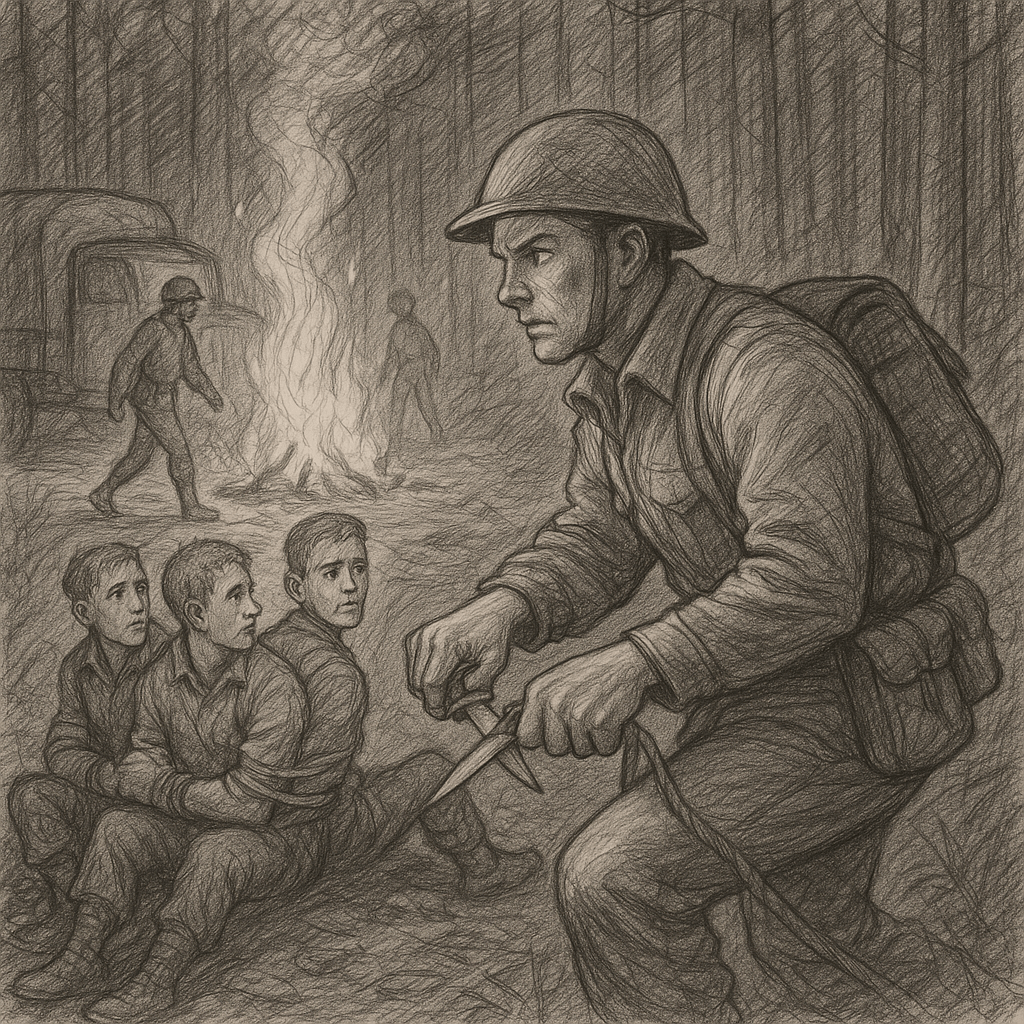
    Cal dropped to his belly and crawled forward, pine needles biting his palms. He couldn’t shoot, not three of them. Even if one was asleep, he couldn’t hit the broad side of a barn. He spotted a pile of brush near the edge of the camp, leftover from clearing the site. A distraction. He sparked his flint. Sparks licked the dry wood until flames bloomed. He waited, letting them hum, roar, and spit smoke through the trees. The guards shouted and bolted toward the fire. Cal stayed low, weaving through shadows, searching. Near a covered truck, he found them, his men, tied together with rope.

    One soldier spotted him. “Messenger?”

    Cal nodded, pulling a knife from his boot and sawing at the rope.

    “You need to go,” the soldier whispered, motioning to the woods. “They’ll be back.”

    “I set a fire,” Cal said. “It’s big. They’ll be busy for a while. We’ll catch up later. Just move!”

    One of the men stared at him, wrists still bound with frayed rope. “Why’d you come?”

    “Because no one else was,” Cal said.

    He grabbed the last man by the arm and yanked. The freed soldiers bolted into the forest, alive, just barely. Cal followed, lungs burning, a scrap of rope still clutched in his fist.

    Whether it was easy or not, orders were orders, and Cal followed them.

  • Doubt Came to Dinner

    Doubt Came to Dinner

    Edward caught a glimpse of a shadow on the last step of his porch. He wasn’t expecting visitors. The figure began to walk up the stairs, slowly, holding on to the railing. It moved with frozen muscles, wooden planks creaking beneath its mud caked boots. Was this person a traveler? Were they lost?

    It became obvious to Edward that the phantom was a man. Was he real? He couldn’t be sure. Removing his glasses he rubbed his eyes to get a better look. When he could see clearly he found the man leaning against the door frame, legs and arms crossed, top hat tilted slightly to one side of his face. The face, concealed by the night was familiar.

    “Doubt, I wasn’t expecting you.” Edward said.

    The man walked over and took a seat next to him on the porch swing, stretched his legs out, and placed an arm across Edwards shoulders. “Do you ever expect me?” Doubt answered.

    The man lifted his head and breathed deeply. “Smells like you have been trying to whip up something nice. Comfort food.”

    Edward nodded, “I guess you are staying to eat?” The man nodded. Of course he was. Doubt never visited without having a taste. He wouldn’t stay long, but the pot would be less full.

    They both entered the home. Doubt moving like a man who had walked a long time. His boots torn at the toes, holes in the knees of his pants, leaving behind the scent of sweat.

    “I thought I buried you?” Edward asked.

    “You did! Boy did you.” Doubt said, displaying the filth on his clothes. “But, not deep enough.”

    Edward started to dip out stew from the pot on the stove. It was the only way he could not look into his eyes. The longer he entertained him, the longer he would stay.

    “I heard you praying over my grave. Pleading that I wouldn’t return.”

    From the kitchen, Edward could hear the crickets chirping like eavesdroppers. Carrying two bowls, he takes a seat at the table and slides one to Doubt.

    Doubt lifts his spoon and blows to cool down the soup. Steam dances around the air coming from his mouth. “My favorite. How did you know? This tastes like faith and promise.”

    Edward watched him consume his meal. The more he stared the less the man looked like something to be afraid of. He became, in the light, almost friendly. Someone who he could share a meal with. Someone he could talk to.

    He looked at Edward over his bowl, “You haven’t touched your food. You are waiting for me to finish, get full and leave. Yet, you should ask me the question you really want to ask. Why I keep showing up? Why can’t you get rid of me? Why do I always come when I smell food?”

    The conversations paused. Doubt’s bowl was empty and Edward filled it back up.

    “Have you ever noticed Edward, that of all those you consider friends, Faith, Love, Joy, I am always the one who shows up first?” The man reached for a piece of cornbread.

    “I didn’t invite you,” Edward responded.

    Doubt smiled, knowing that there was truth in that statement. It is the most honest thing Edward had said all evening. “Do you have to be invited in order to be useful?” Doubt asked.

    Edward began to recall all the moments he spent with Doubt. When his mother was dying of cancer. The evening after a philosophy lecture in college where the professor made an argument that an educated and intellectual person could never believe in God.

    “I used to think that feeding you meant that I would amount to nothing. That your real name was Fear.” Edward took the first bite of his soup.

    Doubt smiled, pieces of cornbread hanging from the corners of his mouth. “It looks like I am just as misunderstood as you are. It’s funny how we assume so much about ourselves and never really take the time to get to know who we really are.”

    “I like to eat. I keep coming back because you keep feeding me, but let’s be honest, Edward, what would you be without me.” Doubt placed his spoon back into his bowl. “You keep preparing these meals because you need me, and I do not want to control you if that is what you think.”

    Edward stared at him, anger filled his eyes. “Yeah, then what do you want?”

    Doubt cleared his throat and took a drink of water, “I want to remind you that you are human. You are hungry, so when you don’t have answers you prepare a meal. I am not the only one that smells it, I am just the first to show up. But, I am not the one to give you answers, I am here to make you uncomfortable with the not knowing.”

    The man across the table began to sound and look human. He started to feel warm, almost comforting. This alarmed Edward.

    “What I mean is, in all of those moments you buried me you found what you needed only after being so kind to share your table with me.”

    “Yeah, and what is that? What did I find?”

    Doubt wiped his mouth with a napkin and got up from the table.

    “It’s time for me to leave, Edward. Don’t worry, I am doing this voluntarily. No need to get a shovel. You have a visitor. I don’t want to impose.”

    Edward watched as Doubt left his home. He felt relief. For once, he didn’t put up a fight, for once he left a small portion in the pot. He didn’t consume all of Edward.

    There was a knock at the door. Edward sat still at the table. Every muscle in his body let loose like elastic that had been stretched too far and too often.

    He walks to the door and finds another man, barefoot and unbeknownst to Edward, it was morning.

    He squinted under the new light of the day, “Are you him?”

    The man stepped inside, “My name is Truth. Do you have a place ready for me?”

    Edward allowed him to step inside and recalled the words of Doubt, “In all those times you tried to bury me, you found what you needed only after sharing your table with me.”

  • The Bird Keeper

    The Bird Keeper

    Ellis moved with precision. Inside the aviary, he knew exactly where he needed to be, what he needed to do, and almost without thinking he danced through his tasks. Exactly two scoops of food per enclosure, humidity levels at just the right setting, and as he passed each bird he would whisper a greeting when he arrived and a farewell when he left.

    This was his sanctuary. A safe place from the world that did not understand him. Birds understood him and he understood birds. His fascination began at a young age, some would call it an obsession. Others might find it a religion of sorts. He was devoted and gave his life, every ounce of who he was to know and understand birds.

    Ellis lived alone, which no one ever thought would be possible. He lived alone, but he was’t alone. He had the aviary. He had a sister who cared for him and made sure that he had all that he needed. Food in the pantry, a clean tooth brush, and toilet paper.

    He didn’t hear the little girl at first. She slipped in one day as Ellis’s sister was dropping off groceries. Seven years old, missing one front tooth. Full of curiosity. She was quiet and methodical with her steps. She merely wanted to see for herself what was making all the noise everyday when she walked by. Ellis’s sister left the door cracked, her hands full of paper grocery bags and the girl knew this was her chance. It wasn’t breaking and entering. She didn’t break anything. It was just…well…entering.

    When she arrived in the front foyer of the home, she followed the sounds, through the back door, into the back yard, and there stood a building of sorts, covered in see through wire. She quietly opened the door, and there sat a large man hovering over a cage whispering.

    “What’s that one called?” she asked, pointing to a bird with feathers the colors of apricots and smoke. The sound of her voice echoed and she immediately noticed that she was far too loud for the moment.

    Ellis tensed. He didn’t like questions. He didn’t do well talking to others, not when they came out of nowhere and unannounced. But, he looked where she pointed.

    “That’s Elijah,” he said softly. Maintaining his whisper. “Doesn’t care for thunderstorms.”

    The girl got up close to the bird, examining him through squinted eyes. “How can you tell?”

    “I just know.” He said, turning back to his task, knowing that he had already spent too much time entertaining her questions. He was behind schedule and that made him anxious.

    The girl sat there and watched. With each cage he followed the same steps, said the same things, but when he arrived at Elijah’s cage he began to hum, and sing softly.

    “Do they know you love them?” She asked.

    He paused his song, smiled and resumed singing. She sat there waiting on him to respond. After the last note he turned to her.

    “They know I listen.”

    She came back the next day. This time she knocked. Ellis came to the door and motioned for her to come inside. She followed him through the house, to the back yard, and into the aviary. She was holding a paper bag of crackers that made a crinkling sound every time she moved.

    “I brought snacks.” she said holding the bag out to Ellis. “They are for me, but I will share with the birds.”

    Ellis shook his head. “No. No. They can’t have them. Too salty.”

    She looked back down at the bag and wiped away crumbs on her chin, and tucked the bag into the pocket of her blue jeans.

    “Right.” she said as she walked through the door.

    The birds were alive with song, their wings providing a steady percussion. Ellis was already inside beginning his tasks. She followed and studied his movements, trying to understand why he was doing each thing without asking any questions.

    He paused.

    “Thank you for thinking of them.”

    She came over once a week after that. Never speaking too much, and admiring the care Ellis took for the birds.

    “I bet you are wondering why a smart and outgoing girl like me comes over here so much?’ she asked.

    Ellis didn’t look up. He was on schedule.

    “The truth is, I don’t have many friends.”She said.

    “My name is Molly.”

    Ellis began to slow down, until eventually he stopped. He listened.

    “I have ADHD, which is just a fancy way of saying I talk a lot and get distracted easily.” She spoke as she paced around.

    “You have no idea how difficult it has been watching you all of these weeks in complete silence.”

    Ellis knew more than she could ever understand.

    She reached in her back pocket and pulled out a book with cartoon looking pictures of birds with descriptions of each underneath. She stretched out her hand to give it to him.

    “I thought you might like this. I bought it at my school’s book fair. It cost me twenty five cents.”

    He took it in his hands and examined it.

    He frowned, “This isn’t accurate.”

    Molly shrugged, “That might be true. But, I thought it was friendly.”

    The word hit differently. Ellis could not explain how it felt. He was behind schedule, very behind. He didn’t care. Ellis the bird keeper now had a friend.

    Inside the aviary, he knew exactly where he needed to be, what he needed to do, and from that day on at least once a week Molly joined him.

  • Frog Pond. The Third Part.

    Frog Pond. The Third Part.

    She nodded and leaned back slightly in her chair, her fingers folding over one another as if she were holding something precious between them.

    “Your father—he wasn’t loud like some of the other men at church. He was gentle, soft-spoken. Thoughtful. The kind of person who’d listen longer than he spoke.” Her voice wavered a little. Her eyes reddened.

    “When your mother sang in the choir, he’d sit in the front pew like she was the only one in the room. Never missed a Sunday. Never missed a chance to remind her how proud he was of her.

    I couldn’t help but smile. It was strange—he didn’t feel like a myth anymore. He felt like a man who’d hold a door open, who’d smell like old books and aftershave.

    Mrs. Rockner continued. “He once told me that he hoped to teach his child—not just to be good, but to be kind. ‘You can be both,’ he said. ‘Kindness takes strength.’” She tapped the cover of the Bible. “And faith takes that same kind of strength.”

    “So you we friends?” I asked, though I was certain I knew the answer.

    “Oh yes, great friends,” She answered. “He and my late husband worked the mines together. In fact, we moved to Frog Pond shortly after he arrived and met your mother.”

    I had heard the stories of how they met. My father arrived in Frog. Pond with nothing but ambition and a suitcase. I am not sure why he settled here. Mother always told me that it was never his intention to stay. Yet, when he met her all those plans went with the wind.

    As the story goes my father arrived on a Sunday morning. He walked through the door of New Jerusalem Baptist church carrying a suitcase. Removing his hat from his head, he placed it against his chest and mouthed, “excuse me.” The preacher stared him down. He should have thanked him though. The man had been preaching with such veracity that the veins in his neck were throbbing. It is possible that my father saved that man’s life. Bless God, he may have croaked preaching the good news. Father sat in the back row, and made sure to give as many “amens” as possible in the remaining five minutes of the sermon. 

    “With every head bowed and every eye closed,” The preacher began his prayer. My father didn’t close his eyes. In the front row sat my mother. Her blonde wavy hair spilling over the back of the pew. He hadn’t been in Frog Pond more than a day, but he knew at that moment he found a home, he found his wife. 

    Every Sunday he returned to the church, eventually he made a habit of going to the evening service too. It was a good ole’ fashioned southern gospel singing. No preacher, just the acapella sound of songs like I’ll fly away and Victory in Jesus. He couldn’t hold a tune in a bucket, but she was there and that meant he was too. It took a while for him to work up the nerve to speak to her. Every week he would move up a pew, until finally he sat next to her, stuck out his hand and said, 

    “My name is Thomas Watson Sanders, and you don’t know this yet, but you will be my wife one day.” If it were any other woman, she would have ran until she reached the Gulf of Mexico, but Mother offered her hand and said, “It’s nice to meet you Mr. Sanders.” 

    I ran my fingers along the cracked spine again, tracing the gold that had survived time and handling. Something stirred in me—something warm, something anchored. For the first time, I didn’t feel like a question waiting to be answered. I felt seen. Rooted.

    “Can I take it home?” I asked.

    “Of course,” she said. “It’s yours. Always has been.”

    As I left the classroom with the Bible tucked beneath my arm, the whispers and stares from earlier didn’t feel so heavy anymore. They were just noise. I had something real now. Something that had passed through his hands and now lived in mine. And as I walked into the church house and slipped into the pew beside my mother, she looked down at the Bible and then up at me.

    Her eyes filled. She didn’t say a word.

    She didn’t have to.

    The church though, was not only where my father met my mother for the first time, it was also the place I met him for the first time.

  • Frog Pond. The Second Part.

    Frog Pond. The Second Part.

    I sat in Sunday school and listened to my teacher talk about Jesus. Mrs. Rockner was reading to us from John 19:27, “Then saith he to the disciple, Behold thy mother! And from that hour that disciple took her unto his own home.” I raised my hand and she called on me to ask my question. 

    “Did Jesus have a father?”, I asked. This was very out of character for me. I rarely ever spoke unless I was spoken to, and never asked questions in fear that I was asking the wrong one. 

    “He was the son of God, doofus”, one of the boys in the back of the room shouted.

    The room erupted in laughter and had my tie not been a clip on I would have choked from the knot that formed in my throat. Mrs. Rockner raised one boney finger to her mouth and shushed the class. 

    “We will not call anyone a doofus in God’s house”, she said behind her clenched teeth. “Tommy”, she called out to me. “Tommy, Joseph was Jesus’ father, but the Bible doesn’t speak a lot about him. It is possible that Jesus grew up without a father.” She grinned at me. She knew why I was asking. I raised my hand again. 

    “Yes, Tommy?”

    “So Mary was a single mom? She took care of Jesus all on her own until he was a grown up?” 

    “I guess you could say that.” She answered, her eyes peering at me over the rim of her glasses. She cleared her throat and continued to teach the class. I couldn’t believe what I was hearing. We came to this building three times a week, twice on Sundays, to talk about him, sing songs about him, we even talked to him, and he was raised by a single mom. Jesus was an important person, and Jesus didn’t have a father. 

    A boy in my class raised his hand, and Mrs. Rockner called on him. 

    “Wasn’t God the father of Jesus?” 

    Mrs. Rockner shook her head in approval. “He was indeed, but I think Danny was curious if Jesus had an earthly father. Isn’t that right Danny?”

    I nodded my head, but kept it hanging below my shoulders. 

    “God is everyone’s heavenly father if they believe in Jesus”, Mrs. Rockner said. 

    I wasn’t sure what she meant by “believing in Jesus” but, if believing in Jesus meant I could have a father, and Jesus was raised by a single mother I wanted to believe in Jesus. I raised my hand again. 

    “I believe in Jesus because he was raised by a single mother.” I could hear tiny whispers travel through the room. Several of my classmates were talking in each other’s ears and covering their mouths with their hands. I knew they were talking about me. They were always talking about me. They were always waiting for me to ask a stupid question, or say something strange. I was different. In fact, I was more like Jesus than any of them. All of them had fathers. I sat there, pinching the skin of my left index finger. I did this when I was nervous. Mrs. Rockner was facing the chalkboard writing our memory verse for the week. She smiled at me, the whispers stopped. 

    “And will be a Father unto you, and ye shall be my sons and daughters, saith the Lord Almighty.” 

    “Tommy, I think that is a great thing. A really great thing,” she said, turning from the chalkboard. 

    Sunday school always ended promptly when it was time for it to. Usually Mrs. Rockner would escort us all to the church house so that we could sit with our parents. Well, in my case it’s just one parent. This particular Sunday, Mrs. Rockner asked me to stay behind and sent everyone else out of the classroom. 

    “Tommy, would you mind staying back with me for a moment?” Without protest, I obliged to her request. This was a welcomed reprieve from the quiet insults thrown at me like tomatoes from the other kids in my class. 

    “Yes, Mrs. Rocker.” I said, walking toward the small desk that sat in the back of the room. She patted the seat of a chair next to the desk, signaling for me to sit down. 

    She always carried a large bag with an embroidered cat on the front of it. I haven’t a clue what she carried in it, or why a person would need something the equivalent size of a suitcase with them at all times. Regardless, after I agreed to her request she started to dig into her bag, looking for something. The bag with its wide mouth appeared to be swallowing her whole until finally she emerged with a leather bound book. 

    “Sorry, I keep my life in the bag. Sometimes things hide from me.” She blew a piece of hair out of her face, and took a deep breath. 

    “Thomas, I have noticed that you ask a lot of questions. Sometimes they are questions that are difficult for Mrs.Rockner to answer. You are a very inquisitive young man.” My face scrunched and my head tilted to the side when she said this. 

    “What I mean is that you want to know a lot about things.” She placed the leatherbound book on the table in front of me. On the front cover, in gold inlaid letters was my name. Thomas Watson Sanders. 

    She placed her hand on the book and looked at me. “Tommy, this is a Bible. Not only is this the Bible, but it is your Bible. See, it has your name on it.” She pointed to the gold letters. The book was worn, and the leather was dry and cracked. The edges of the cover were starting to tear. The gold gilding had long worn off, some of it was still visible though dull. I had never seen a book like it. Two columns of words on each page.The front of the book had a page for a person to put there name, births and deaths of family members, and even a place for marriages. On the page for the owners name, written in blue ink, 

    Presented to: Thomas Watson Sanders

    With Love. Your Wife, Elenore. 

    This was his. Held held it in his hands. I stared for what seemed like an eternity, running my fingers over his name, imagining what these pages would tell me if they could talk. I flipped page after page to find notes in his handwriting. This was the closest I had ever been to my father, and for just a moment time stood still. 

    “Years ago I found this while going through some old books in the church,” she placed a hand on mine. “He must have left it here the Sunday before the accident.” 

    I cried. I am not sure why it cried. I never grieved his death because I never knew him. How does a person miss something that they never had? I am certain that the feeling that I felt in that moment was grief, because for the first time my father became a real person to me, not some fantasy in stories, but a real person. I sucked up a wad of snot and gathered myself so that I could speak. 

    “Did you know him?” I asked. 

    “Oh yes, I knew him very well,” She said. “Would you like for me to tell you about him.”

    “Yes, very much so.”

  • 76.33 years.

    76.33 years.

    The average life expectancy of a person in the United States is 76.33 years. I don’t know how you feel, but that just doesn’t seem like a lot of time.

    Both of my maternal grandparents lived well into their 80’s, and over 50 of those years they spent together.

    We do not live in a time when people stick with things for very long. Boredom is the epidemic of the age. Mostly it’s because we are selfish people. Sounds harsh, I know. You know it’s true.

    On average a person changes jobs 12.4 times between the ages of 18 to 24.

    On average a person moves 11.4 times in their lifetime.

    On average 42% of all marriages end in divorce.

    These averages tell us something that I think we all know is true, and the sooner we admit them the more likely we will be to change them. We abandon ship the moment the ship fails to meet our needs. We don’t repair the sails, we replace them. We don’t patch the holes . We let the ship sink, cash in the insurance money, and buy a new one.

    The truth is, the new ship is just as susceptible to torn sails and holes as the old one was.

    I spent most of my childhood at my grandparents house. Almost every formidable memory I have was made there.

    My Nanna was a saint, and I’m convinced that if anyone was to be taken to Heaven in a chariot it would have been her. She was classy. Regardless of the itinerary for the day, she fixed her hair and put on make up. I can still smell the hairspray she used, and her perfume.

    My grandfather was a hard working man. He had rough hands. All of his pants were stained with dirt and grass. I do not recall a single moment that he didn’t have chewing tobacco in his mouth. He didn’t talk much.

    When I was a kid I received one spanking from my grandmother. Back then we had to go into the yard and pick our switch. For you non-southern folk, a switch is a thin piece of tree branch that felt like fire ants when you were hit with it.

    My grandfather wasn’t much for switches. He once chased my brother around the yard with a 2×4. I’m not sure what he did to deserve that, but thank the good Lord that he was fast on his feet.

    I was 11 years old when my grandfather died, and 22 years old when my grandmother died. It seems impossible to interpret my memories of them together in the context of marriage.

    They were very different people, with a very different outlook on the world. I never saw them hug or hold hands. I never saw them kiss each other goodnight.

    What I did see is my grandmother care for him when Alzheimer’s took over. I saw her next to his death bed, ushering him out of this life into another.

    I saw him work the ground to provide food for his family. I saw the house he worked to build. I saw a family gather around a table almost every night. A family he spent his life, sweat, and blood providing for.

    When they were together, I didn’t know it then, but they were teaching me about marriage. They were teaching me that the holes are worth patching and the sails are worth fixing. The ship may take on a little water, and it’s a whole lot of work to keep it.

    I always wondered how they made it through, but I get it now.

    Sailing isn’t easy, but it sure beats sinking.

    While newness is exciting I think what all of us really want is consistency in our lives. Maybe that is why we are so prone to move around, to change. What we don’t want to admit is that what we really want requires work, and nothing is more at war with our flesh than work.

    76.33 years isn’t long at all.

    Spend it how you want. I for one am learning how to repair sails and patch holes.

  • Frog Pond. The first Part.

    Frog Pond. The first Part.

    My father died before I was born, and then showed up in my life eleven years later. I learned of that day through stories and newspaper articles. If a person wanted to know about that day, it wasn’t difficult to find information. It was the most famed event in our small town of Frog Pond. News papers all over the south ran stories about it from Thanksgiving to New Years. Local papers ran it right next to the discovery of King Tut’s tomb, and the election of the first female U.S. Senator.

    That day there was a thick gray haze in the air, common to any mining town. It was hard to distinguish at times between when the sun went down and when it came up again. Every surface was covered with a thick and deathly dust. My mother packed my father’s lunch in a metal box, and waited for him to get dressed, drink his coffee and leave. She would follow him out to the front yard, hand him his lunch and kiss him on the cheek. 

    “See you in a little bit,” he said. According to my mother, it was always the same words of departure. See you in a little bit. There was an expectation that at the end of my father’s shift, my mother would be woken by the creaking sound of the front screen door. 

    Some mornings my father would drive to work, other times he would walk. Our home, which was no bigger than a match box, and sat three miles from the number three mine where he worked. On this day, he decided to walk. I have walked the same route many times. I would imagine that I was matching him step for step. He passed two churches. The baptist church on his right and the Methodist church on his left. Both congregations shared a cemetery. I guess when you’re dead it doesn’t really matter if you were baptized as a baby or not. All that matters is that the water knocked the sin out of you. Truth be told, the town was not big enough to have more than one cemetery. 

    A small distance from the methobaptist cemetery was the number three mine. Every abled body man in Frog Pound and some neighboring towns worked at the mine. Coal dust was just as much in our veins as it was in the air we breathed. Most boys never finished school, because there was mining to do. My father on the other hand was perhaps the only man underground with more than a fifth grade education. He could read and write. He was not a native to Frog Pond, and if you asked anyone who knew him, he made that abundantly known wherever he went. He volunteered to read the scripture every Sunday. He could have done anything. He could have been anyone. For some reason, unknown to anyone still living, he chose to be a miner. 

    Had it not been for the events of this day I myself,  after completing grammar school,  I would ‘ve started digging. I happened to like school. I started reading at a very young age. I owe this to my mother. She insisted that I learn, and worked tirelessly to teach me the craft. I read everything from the grocery list, to the book of John. This left a conflicting feeling in my gut. I lost my father on this day, but I escaped coal. My father gave his life for my own. 

    On his way underground, my father would have passed a sign that displayed the quota of the day. Coal miners and police officers had one thing in common, and I mean only one thing, the more they put in the wagon, the better off they were. The boss men at number three were aiming for a record day. “52,000 tonnage for November!,” the sign read. This would have been the second month in a row that number three would have broken a record, and the powers that be wanted it more than a squirrel wants a nut. My father was one of four hundred and seventy five men who would bathe in black soot to give the fat rodents their nuts. 

    Coal was transported from the seam to the surface in carts that were moved by an electric cable system. One car at a time, in groups of three. No one knows exactly what went wrong, but carts at the surface of the mine became jammed. The operators tried to jerk them free, but the force was too much for the cables and the carts began their descent back to the pit from which they came. A dark descent.  All anyone at the surface could do was watch.. and wait. The large steel boxes barreled toward the bottom of the slope. A metallic hum trailing down the pit.  Newton once said that an object in motion will stay in motion unless something stronger stands in its way. At the bottom of the track, three very full containers were waiting to make their ascent, that is until their rogue companions crashed into them. Newton was right.

    A cloud of smoke filled the cavern. One of the cables to the electric carts snapped and a spark kissed the dust. It happened so fast, no one had time to even jump from the fright. The explosion roared and the next thing they knew they were trapped in blackness. A dark confinement.  The explosion was felt nine miles away in Birmingham, and it was said that the smoke could be seen in Montgomery. I don’t know if that last part is true. Those that survived said that it knocked them clear off their feet.

    “I had never heard or felt a thing like it,” Roger Mule said. “One minute I was loading a cart, and the next I was picking coal out of my skin and hacking dust out of my chest.” Mr. Mule’s story was one of a few that was told in the newspapers in the following weeks. 

    “The good Lord saved me.” He fought back tears. That isn’t something you saw much of in Frog Pond, a grown man crying. 

    “God himself got me out of that mine.” Mr. Mule was known for smoking a corn cob pipe. I can see him now, speaking these words out of one side of his mouth as the other side held his pipe between his teeth. 

    The entire town rushed to the scene. Only a few people had an automobile. My fathers truck sat in our front yard. Mother didn’t know how to drive, but she learned that day. 

    When she arrived at the mine, everyone was sitting on pins waiting to see if their husband, son, or grandson would be the next body to either walk out, or be pulled out. Most of those pulled out were covered by a shirt, coat, or blanket if one was available. They were dead. Dread, grief, or thankfulness. Some said that they felt all three at once, or two at a time. Joy was absent. Joy would come later, but not for all. Joy was only possible when the dust settled and for the first time in modern memory, the sun was bright in Frog Pond. My mother felt dread and grief, sometimes simultaneously, sometimes separately. She never felt joy. My father neither walked out, nor was he pulled out. 

    “Ma’m, it’s getting dark. Why don’t we get you home,” Earl Watson said to her. Earl owned the hardware store in town. He was one of the few men who didn’t dig for a living. He’d much rather sell the shovels. 

    “I can’t. Not until Thomas is found.” her eyes were fixed on the opening of the mine. 

    “Elenore, they will find him. Have faith.” He placed a hand on her shoulder. 

    Mother stood there cradling her face with her hands, sobbing, watering the black ground with her tears. She overheard some men talking about returning the next day to continue looking for survivors. Every day she would return with them. She would follow the same routine that her and my father had always done. She packed a lunch, walked outside, and when she got in the yard she would whisper to herself, “See you in a little bit.” Some days she would drive. Other days she would walk and pass by the Methodist church on her left and the Baptist church on her right. She would wait, until one day there was nothing to wait for. The mine closed and my father’s body was presumably dead and buried somewhere, hundreds of feet below the surface.He was never found. Earl was wrong.

    The day after the mine closed my mother found out that she was pregnant. In all the different times, and different versions of the stories I have heard about this day not once was I told that my mother felt dread or grief that day. Finally, joy came in the morning. There would be time for dread, and I am sure there was. Though she would have never told me, life in Frog Pond would not have been easy for a widow, much less a widow with a baby. 

    She rubbed her belly, “See you in a little bit.” I was named after my father, Thomas Watson Sanders. 

  • Ding, Ding.

    Ding, Ding.

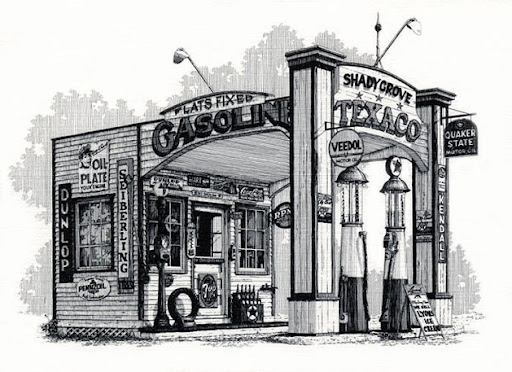
    Texaco gas station. Pleasant Grove, AL.

    I started my car today and got a mile from my house and the gas light came on. The sensible person would find the nearest gas station and fill up. I’m rarely sensible and I never fill up. It’s always the same. Five miles until empty and twenty on five please.

    I just don’t like pumping gas. It’s easy. It doesn’t take up much time. But, it’s awfully inconvenient. It reminded me of a time, not too long ago, when going to the gas station was quite literally one of the best parts of my week.

    The old school across the street was a tall two story building. The outside was wrapped in planks. White planks to be exact, though decades of age started to peel it away. A few yards from the front door of the old school was an out house. The structure was a relic. A monument of a time that was. All of town seemed to move away from that time. A new an improved school built behind it, and now an even newer school built down the road. The school was there before self check outlines at the grocery stores, and before two day shipping. It sat empty, watching over a town that had long since forgotten how important it was.

    Yet, across the street was the Texaco. There were two pumps, and a mechanic shop. There were other gas stations in town, more modern ones. I remember when car washes were installed. But, you couldn’t compete with the Texaco.

    As you pulled up you would run over the black cable that stretched across the lot. When you did a bell would ding with each passing of your tires. Ding. Ding.

    Upon your arrival a man in greasy coveralls approached your vehicle. I can’t remember his name but it was sewn into a patch on the breast of his outfit.

    On the side of each pump was a black bucket full of water with a squeegee. One side was a sponge of some sort and the other was made of rubber. The gentleman with either a cigarette in the corner of his mouth, or drips of tobacco hanging from his lip would tip his hat to you as he cleaned the windshield.

    “Five dollars please.” the financial exchange happened and the man began to pump your gas.

    I looked forward to this. The dinging of the bell. The windshield being cleaned. The place wasn’t clean by any means, but it sure was convenient.

    I didn’t know it then, but this place was the last of its kind. Sooner or later it would join the school house and watch as the world moved on with out it.

    We can leave the out house in the past, sorry old school, but I would give my last pair of socks to go back to that old Texaco.

    Ding, ding.